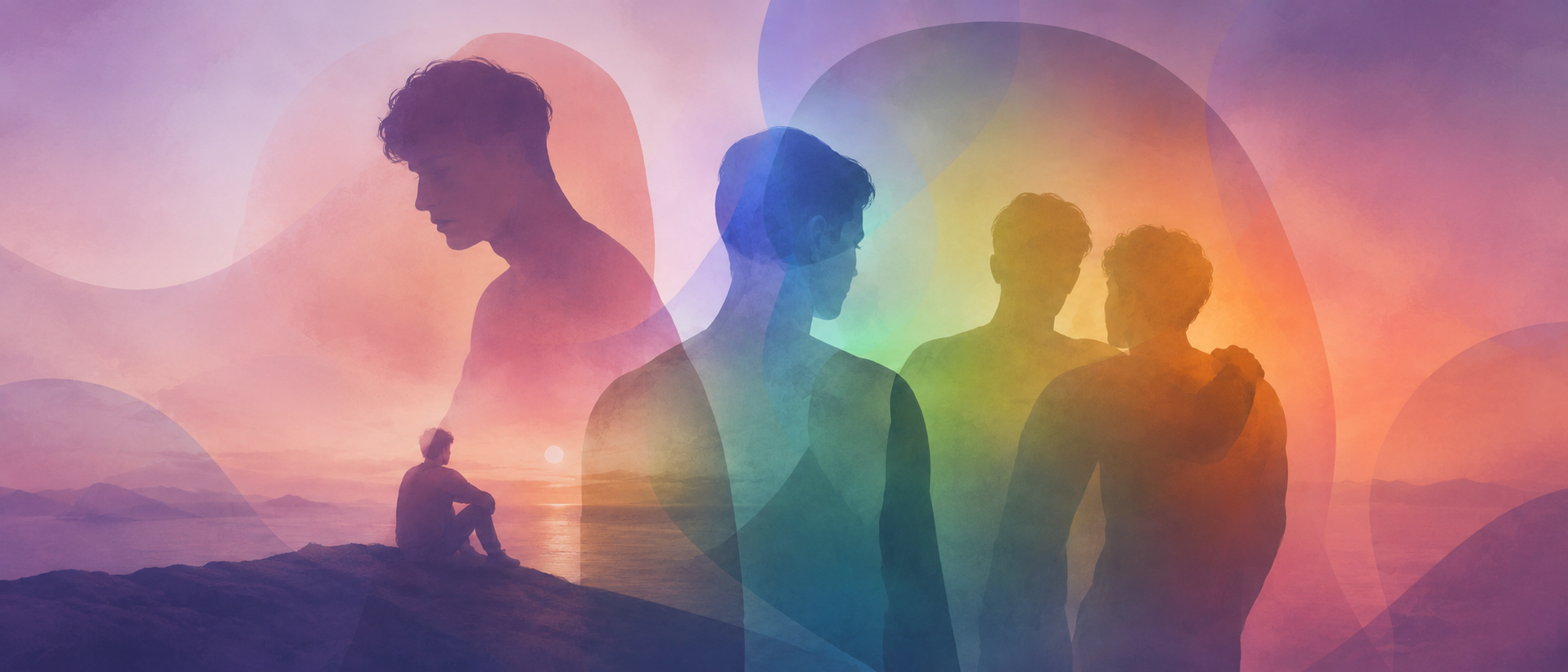
What If Pride Makes You Feel More Alone Than Proud?
Your story can be more complicated than a rainbow post can hold.
Pride Month 2026 just came to an end. This month gave me the chance to attend a few 2SLGBTQIA+ related trainings and conferences, and to co-host with psychologists who have been doing meaningful work with gay men for a long time.
Like many have observed, there is a version of gay life getting shown a lot online. —— Pride events. Circuit parties. Chosen families. Confident Selfies. Friend groups that look perfect and effortless. Dating, traveling, gathering, healing, glowing up, and being “unapologetically yourself.”
And then, there is the quieter version many gay men actually live with. —— You may be out, but still feel guarded. You may support Pride, but not feel like going to a parade. You may want gay friends, but feel unsure where to find them. You may have tried dating apps hoping to meet people who want more than a hookup, only to feel disappointed when the conversation turns into “looking?” You might have gone to gay bars, queer events, or online spaces hoping to feel more connected, but still walked away feeling lonely.
You might scroll through Instagram and Tiktok and see people talking about how toxic the community can be. Part of you may feel relieved because someone finally said it. Another part of may feel guilty for agreeing.
Because we are not really “supposed” to say that, are we?
In a “should” world, we are supposed to be grateful once we find community. We are supposed to feel proud, free, confident, and connected. We are supposed to celebrate our sexual identity and orientations, especially after everything this community people have fought for.
However, what happens when the community you hoped would feel like home also makes make you feel judged, invisible, or not enough?
That is a painful place to be. And it is more common than people admit.
Community can be healing, but it is not automatically safe.
For many gay men, finding other gay people can be life-changing. There is something powerful about not having to explain everything. You don’t have to explain why certain comments hurt. You do not have to explain why family acceptance is complicated. You do not have to explain why a small public gesture, like holding hands on the public street in a conservative city, can still make your body tense.
Being around people who “get it” can feel like breathing for the first time. But, community is still made of people. And, People can and will carry their own insecurity, shame, trauma, competition, racism, body judgement, classism, masculinity rules, and emotional avoidance into the space they fight for or create. That is to say, gay spaces can be beautiful, joyful, funny, loving, and life-saving. Meanwhile, they can be cliquey, cold, sexualized, image-focused, and hard to enter if you do not already feel confident.
You can love your community and still feel hurt by parts of it. You can believe in Pride and still feel disconnected from some Pride culture. You can want gay friendships and still feel exhausted by the way some gay spaces operate. I am just trying to say, that does not make you bitter. It makes you honest.
Online gay spaces can feel especially hash.
For gay men in smaller cities, rural areas, conservative provinces, immigrant families, or places where being openly gay still feels risky, the internet can become the first place to look for connection. Sometimes it helps. Online spaces can give you language, humour, visibility, and the feeling that you are not the only one. They can help you realize that your experience has a name. They can make you feel a little tiny bit less alone at 2 a.m. when nobody around you seems to understand.
But online gay culture can also be sharp.
Gay dating & hookup apps, Collective, Instagram, Tiktok, Reddit, X, and local gay groups can quickly turn into places of comparison. Who is attractive enough? Masculine enough? Fit enough? Funny enough? Popular enough? Young enough? Successful enough? Open enough? Experienced enough? Confident enough? It’s like a message being thrown out there: be proud, but only if you look good doing it.
It can be confusing. The same spaces that talk about acceptance may still rank people by many things, such as body type, race, age, masculinity, sexual role, income, relationship style, or HIV status. The same people who talk about trauma may still dismiss others with one-word replies, public shaming, or casual cruelty. When you have already been carrying years of feeling “different,” rejection from other gay men can cut deeply.
It may bring up the old question: “What is wrong with me?” You probably know what I am gonna say, the problem is not that you are wrong. The problem is that many gay men are trying to connect while still carrying their own wounds.
In-person spaces can be easier?
Some people may assume the problem is only online. So, they just delete the apps, stop scrolling, and meet people in real life. But in-person gay spaces can be complicated too?
A bar/ club may feel too sexualized. A Pride event may feel overwhelming. A sports league may already have its own social circle. A queer group may feel politically intense. A small-town gay scene may feel too visible, where everyone know everyone’s business and privacy feel impossible. At the end of the day, you may walk into a room full of gay men and still feel alone.
Not because you are anti-social. Not because you are insecure. Not because you are failing to be gay. Sometimes, your body may be simply asking, “Am I safe here?”
That question may come from past bullying, family rejection, racism, body shame, religious trauma, immigration stress, social anxiety, or years of hiding parts of yourself. Of course, it may also come from real experiences of being excluded or judged within gay spaces. It all makes sense that connection can feel complicated when connection has not always been safe.
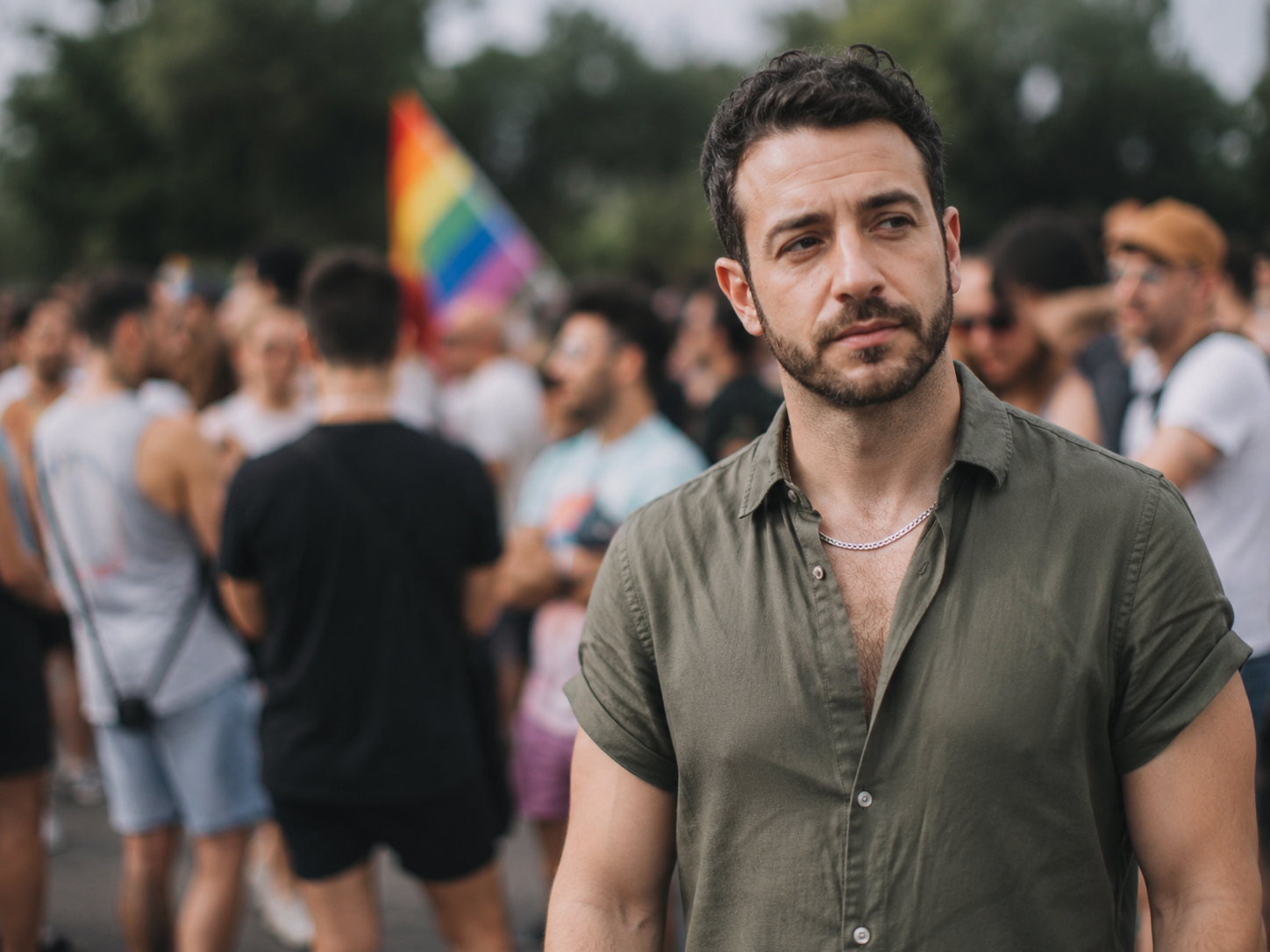
Not feeling Pride all the time does not mean you are ashamed.
Sometimes, there can be a quiet pressure in gay culture to be proud in a very specific way.
Be loud. Be confident. Be visible. Be healed. Be sex-positive. Be body-positive. Be politically clear. Be ready to celebrate. These can be beautiful goals, but when they become emotional rules, they backfire.
Maybe Pride month makes you feel hopeful and lonely at the same time. Maybe you are out, but still careful around family or coworkers. Maybe you want connection, but the apps make you feel disposable. Maybe you want to date, but the process feels strange and draining. Maybe you want gay friends, but you do not know how to enter spaces that already seem formed without you.
None of that means you are failing or ashamed.
Feelings are not moral statements. Feeling disconnected does not mean you hate the community. Feeling hurt by gay spaces does not mean you are anti-gay. Feeling tired of online drama does not mean you are weak. Feeling uncomfortable at Pride does not mean you are not proud. The pride can be quieter. It can be telling the truth about what hurts. It can be admitting that you want more than surface-level belonging. It can be noticing that you no longer want to abandon yourself just to be accepted.
You are allowed to build a different kind of GAY life
There is no single correct way or best way to be gay.
You don’t have to love nightlife. You don’t have to enjoy dating/hookup apps. You don’t have to be sexually open to prove you are liberated. You don’t have to be loud about your identity if quietness feel safer right now. You don’t have to force yourself into spaces that repeatedly make you feel small or struggled to be seen.
Your gay life can be slower with tranquility. It can be soft and private. It can include only a few close friendships instead of a big chosen family. It can include one partner, or no partner. It can include a gay book club, a gaming group, a private online space, a long-distance friend, an affirming therapist, a few people who do not require you perform confidence before they offer care.
For gay men living in smaller cities, culturally conservative areas, immigrant families with different attitudes about this, or provinces / cities where the social climate can feel mixed. Sometimes, you may not have easy access to a large affirming community nearby. Sometimes the local gay scene may feel too small, to exposable, too cliquey, or too risky. In those situations, support may need to be built more intentionally and sometimes more privately.
However, that does not make your life less valid. It just means your version of connection may look different.
Please ask yourself a gentler question.
When you feel disconnected from the gay community, it is easy to turn the pain inward.
“Why am I not more confident?” “Why do I always feel socially awkward or intense?” “Why do they always get noticed and I just… don’t?”
Maybe, the better question is: “What kind of connection actually helps me feel more like myself?”
This question is different. It doesn’t assume you are the problem. It gives you room to notice what your nervous system, culture, identity, and values actually need.
Maybe you need spaces that are less focused on appearance. Maybe you need friends who can talk about emotions without turning everything into a joke. Maybe you need people who has the wisdom about culture, race, immigration, family complexity, faith, neurodivergence, body image, or growing up in a place where being gay was unsafe or did not feel safe. Maybe you need to grieve what you did not get earlier in life. Maybe you need to stop forcing yourself into spaces that keep confirming old wounds. Maybe you need LGBTQ+ affirming support, not because therapy has to replace community, but because it gives you a space to sort through the hurt, the void, and not rush you into “just be proud of who you are” before you have had room to be honest, patient and caring to yourself.
You deserve more than survival. You deserve connection that lets you breathe at your pace. You also deserve more than being accepted only when you perform the right version of being gay.
If Pride does not feel simple for you, that doesn’t mean you are broken or internalized homophobic. It may simply mean your story is more complicated than a rainbow post can hold.